
(707) 525-8800
Call Us Today
(707) 525-8800

Business Valuation in a California Divorce: What Business Owners Need to Know
In a California divorce, a business started during the marriage is generally community property, and its value is divided equally. A business owned before the marriage can still include a community share if it grew because of either spouse's work. An expert usually values the business, and in most cases the owner keeps it and the other spouse receives other assets or payments of equal value.
For a business owner, divorce raises a practical worry on top of a personal one: can the business keep running while the marriage is being divided? In most cases it can. Three questions shape what happens.
Question 1: How Much of the Business Is Community Property?
California presumes that property acquired during the marriage is community property (Fam. Code §760). That includes a business started during the marriage, even if only one spouse works in it and even if it is in only one spouse's name. Community property is divided equally unless the spouses agree otherwise in writing (§2550).
A business owned before the marriage generally starts as separate property (§770). But if it grew during the marriage, part of that growth may belong to the community. California courts use two methods to divide that growth, and the court can choose whichever is more fair in the circumstances:
- The Pereira approach is generally used when the growth came mainly from the owner's personal effort and skill. The separate property share is the business's value at the date of marriage plus a reasonable rate of return. The rest of the growth is community property.
- The Van Camp approach is generally used when the growth came mainly from the nature of the business or market conditions. The community receives the value of a fair salary for the owner's work during the marriage, less what was already paid to the family. The rest stays separate property.
Which approach fits can make a large difference in the result, so it is worth understanding early. A prenuptial or other written agreement between the spouses can also change the analysis.
Goodwill can be part of the value. Goodwill is the value of a business's reputation and customer relationships beyond its physical assets. California courts recognize goodwill as a community asset, including in professional practices such as medical, dental, accounting, and law practices (In re Marriage of Foster). Factors include the business's location, its client base, how long it has been established, and the owner's skill and reputation.
The valuation date matters. California generally values community assets as near as practicable to the time of trial, but a court can choose a date after separation and before trial for good cause (Fam. Code §2552). With a business, value can change after separation because of one spouse's continued work or market shifts, so the date is often an important part of the discussion.
Both spouses must disclose fully. California requires each spouse to give a full and accurate disclosure of all assets, debts, income, and expenses, and to update it if anything material changes (§2100). For a business, that typically means tax returns, financial statements, bank records, and ownership documents. The duty applies in mediation as well as in court.
Question 3: Who Keeps the Business?
Once you know the community share and the value, you can decide what happens next. Common outcomes include:
- The owner keeps the business and the other spouse receives offsetting assets. For example, the house, a larger share of retirement accounts, or investments. This is a common result. Our article on who gets the house in a California divorce explains how a home buyout works.
- The owner keeps the business and pays the other spouse over time. Structured payments can work when there aren't enough other assets to balance the division. The agreement should spell out the schedule and what secures the payments.
- The business is sold and the proceeds divided. This tends to fit when neither spouse wants to run it or when it depends on both of them.
- Both spouses stay owners for a period. This is less common and works only when the spouses can keep working together.
Each option has tax consequences, and different assets are not always worth the same after tax. A CPA should review any proposed division before you sign.
Why Mediation Makes Sense for Business Owners
What to Say
Litigation can put your business's financial details into the court record and leave a judge to choose between competing experts. Mediation gives you more control:
• One neutral expert. Many couples jointly hire a single valuation expert and agree in advance on the scope of the work and how the cost is shared.
• Privacy. What is said in private mediation is generally confidential and can't be used as evidence later (Evid. Code §1119).
• Business continuity. You can build in protections for employees, clients, and day-to-day operations while the divorce is pending.
• Creative structures. Offsets, payment schedules, and timing tied to business cycles are easier to negotiate than to win in court.
Divorce Mediation for Business Owners in Santa Rosa
Marla Keenan-Rivero brings more than two decades of California family law experience to divorce mediation for business owners and couples with complex finances. She helps spouses work through how much of a business is community property, coordinate with valuation experts and CPAs, and put the final agreement in writing so it can be submitted to the court. Sessions are offered in half-day and full-day formats.
Frequently Asked Questions
Is my business community property in a California divorce?
A business started or acquired during the marriage is generally community property. A business owned before the marriage generally starts as separate property, but the community may be entitled to part of its growth during the marriage if that growth came from either spouse's work.
How is a business valued in a California divorce?
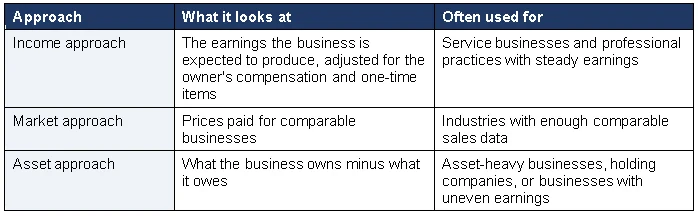
A valuation expert usually uses one or more standard approaches: an income approach based on expected earnings, a market approach based on sales of comparable businesses, and an asset approach based on what the business owns and owes. Goodwill can also be part of the value.
Do I have to sell my business if I get divorced?
No. Often the spouse who runs the business keeps it, and the other spouse receives other assets or payments equal to their share of the business's community value.
Can we hire one valuation expert instead of two?
Yes. Many couples in mediation jointly hire one neutral valuation expert and agree in advance on the scope of the work and how the cost is shared. This often saves time and money compared with each side hiring its own expert.
What if my spouse started the business before we were married?
The business generally starts as separate property, but growth during the marriage can include a community share. California courts use the Pereira or Van Camp approach to decide how much, depending mainly on whether the growth came from personal effort or from the business itself.
Protect your business and your agreement. Schedule a consult today: call (707) 525-8800 or email Tidwell@perrylaw.net.
Resources
- Collaborative Divorce vs. Mediation
- Same Sex Divorce Mediation
- Property Division Mediation
- Divorce Mediation vs. Litigation in CA
- Online Divorce Mediation California
- What Are the Three C's of Divorce?
- What Assets Cannot Be Touched in a Divorce in California?
- Who Gets the House in a California Divorce?
- How to Prepare for Child Custody Mediation in California
- Business Valuation in a California Divorce
Follow Us On
©2026 Marla Keenan-Rivero Family Law Mediation
The information on this website is provided for general informational purposes only and does not constitute legal advice.