(707) 525-8800
Call Us Today
(707) 525-8800
How to Prepare for Child Custody Mediation in California: What to Say and What Not to Say
Prepare a proposed parenting schedule, gather your children's school, activity, and medical information, decide what matters most to you, and keep every statement focused on your children's needs, not your co-parent's past behavior. In Sonoma County court mediation, what you say can shape the counselor's recommendation to the judge.
Most parents walk into custody mediation without knowing what kind of session it is or what happens to what they say. That uncertainty causes more problems than any single wrong sentence. Start with the type of mediation you're in, then prepare for it.
First, Know Which Kind of Mediation You're In
In California, when parents file papers that show they disagree about custody or visitation, the court sends them to mediation before a hearing (Fam. Code §3170). Parents can also choose a private mediator at any point, before or after filing. The two are very different.
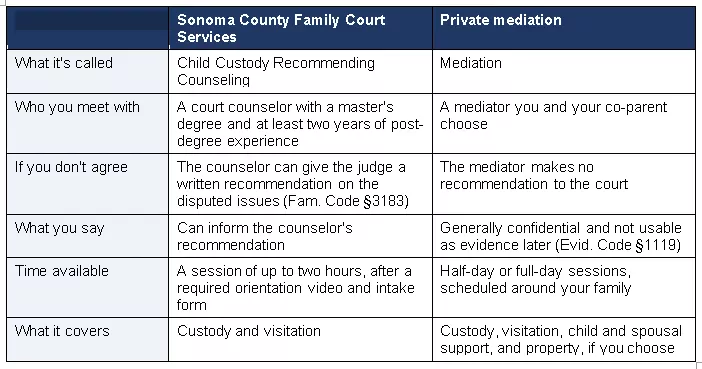
In a recommending county like Sonoma, how you come across in the session matters. You are working toward an agreement, and if you don't reach one, the counselor's view of the issues goes to the judge in writing before your hearing. In private mediation, you can explore options more openly because the process is built around reaching your own agreement.
Five Steps to Prepare
1. Draft a proposed schedule. Write out a regular school-year schedule, plus holidays, birthdays, school breaks, and summer. A specific proposal is easier to discuss than a general goal.
2. Gather the facts. Bring your children's school calendars, activity schedules, health and therapy appointments, and both parents' work schedules. Decisions are easier when the details are on the table.
3. Decide your priorities for decision-making. Legal custody is about decisions on your children's health, education, and welfare. Physical custody is about where they live and when. Know which decisions you want to share and where you need a clear process if you disagree.
4. Plan the logistics. Think through exchanges, transportation, how you will communicate with each other, and how travel or a future move would be handled.
5. Know where you can be flexible. Decide in advance which points matter most and where you have room to give. Mediation works when both parents arrive ready to adjust.
Two practical notes for court mediation in Sonoma County: the orientation video and intake form must be completed before your session, and children should not come with you.
Custody Terms to Know Before You Go
What to Say
The most useful statements describe your children and propose a solution. For example:
• "Our son does best when the school week is predictable, so I'd like exchanges on Fridays after school."
• "I want both of us at the parent-teacher conferences. Can we agree on how we share school information?"
• "I'm open to alternating Thanksgiving if we can keep Christmas morning consistent."
Mediation isn't won. It's settled. Parents who arrive with a concrete, child-focused plan and listen to the other parent's plan tend to leave with more of what matters to them.
What Not to Say
1. Re-arguing the marriage. Past grievances don't help build a schedule, and they shift the focus away from the children.
2. "My child" language. Saying "our children" signals that you see the other parent as part of their lives.
3. Absolutes. "He never shows up" or "she always cancels" invites a fight. Describe specific facts instead.
4. Threats or ultimatums. "If you don't agree, I'll take this to court" ends the conversation.
5. Putting the children in the middle. Don't present what the children told you about which parent they prefer as a bargaining point.
Questions to Ask Your Mediator
• What happens if we agree on some issues but not others?
• How does our agreement become a court order?
• Can we include holidays, travel, and future moves in the plan now?
• Can we also work out child support in the same process?
How Long Custody Mediation Takes
In Sonoma County, a Family Court Services session can last up to two hours. Arriving late or unprepared can shorten the time available. Private mediation is usually scheduled in half-day or full-day sessions. A complete parenting plan, especially one that also addresses support or a potential move, may take more than one session.
Mediation is not the right fit for every family. If there is a history of domestic violence or a protective order is in place, you can ask to meet with the court mediator separately (Fam. Code §3181), and you should talk with an attorney about whether private mediation is appropriate.
Private Custody Mediation With Marla Keenan-Rivero
Marla Keenan-Rivero brings more than two decades of California family law experience to child custody mediation in Santa Rosa and throughout Sonoma County. Working with a private mediator gives parents more time than a court session, a confidential setting, and the option to resolve custody, support, and property together. When you reach an agreement, Marla helps put it in writing so it can be submitted to the court for approval.
Frequently Asked Questions
What should you not say in child custody mediation?
Avoid re-arguing the marriage, criticizing the other parent, speaking in absolutes like "always" and "never," making threats or ultimatums, and putting the children in the middle. Keep every statement focused on what your children need.
What should I ask for in child custody mediation?
Ask for a specific schedule that fits your children's routines, a clear process for shared decisions, and plans for holidays, school breaks, travel, and communication. Specific proposals are easier to agree on than general requests.
How long does child custody mediation take?
In Sonoma County, a Family Court Services session can last up to two hours, after a required orientation video and intake form. Private mediation is usually scheduled in half-day or full-day sessions, and a full parenting plan may take more than one session.
What happens at child custody mediation in Sonoma County?
You meet with a Family Court Services counselor to try to reach an agreement on custody and visitation. If you agree, the agreement goes to the judge for approval. If you don't, the counselor can give the judge a written recommendation on the disputed issues before your hearing.
Is what I say in custody mediation confidential?
It depends on the type of mediation. In Sonoma County court mediation, the counselor can make a written recommendation to the judge if you don't agree. In private mediation, California's mediation confidentiality rules generally prevent what is said from being used as evidence later.
Can we use a private mediator instead of Family Court Services?
Yes. Parents can work with a private mediator at any point. If you reach an agreement, it can be written up and submitted to the court for approval. Private mediation can also cover child support, spousal support, and property.
Does putting an inheritance into a joint account automatically make it community property?
Not necessarily. Mixing separate and community funds can make the characterization of the money more complicated, but commingling alone does not always eliminate a separate-property claim. The ability to trace the funds back to their separate source is often critical.
Prepare with a plan, not a script. Schedule a consult today: call (707) 525-8800 or email Tidwell@perrylaw.net.
Resources
- Collaborative Divorce vs. Mediation
- Same Sex Divorce Mediation
- Property Division Mediation
- Divorce Mediation vs. Litigation in CA
- Online Divorce Mediation California
- What Are the Three C's of Divorce?
- What Assets Cannot Be Touched in a Divorce in California?
- Who Gets the House in a California Divorce?
- How to Prepare for Child Custody Mediation in California
Follow Us On
©2026 Marla Keenan-Rivero Family Law Mediation
The information on this website is provided for general informational purposes only and does not constitute legal advice.